
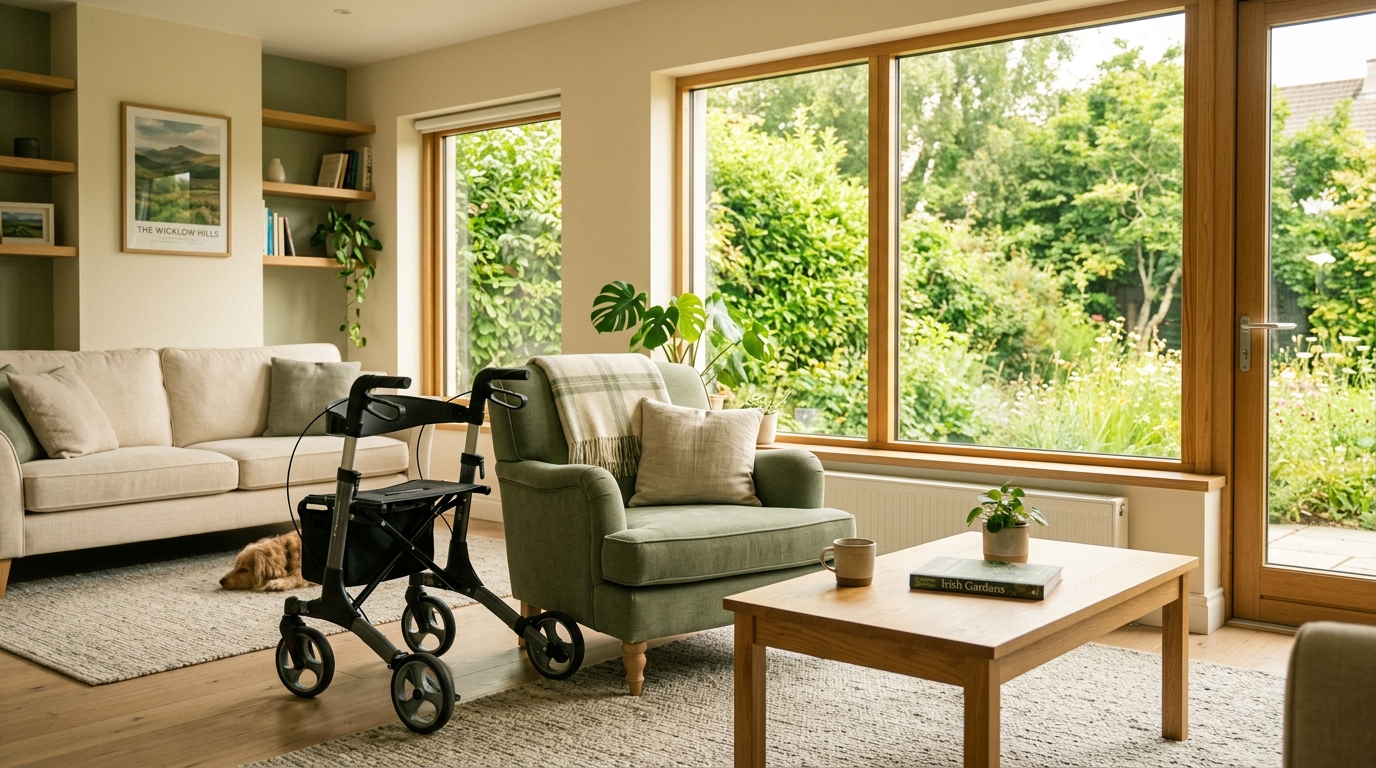
Navigating financial support for mobility aids in Ireland can feel overwhelming — but in 2026, there are several well-established grant schemes designed to help cover the cost of equipment and home adaptations that support independent living. Whether you are exploring a rollator, a wheelchair, or home modifications to improve accessibility, understanding which grants apply to your situation is the essential first step.
This guide brings together everything you need to know about mobility aids grants in Ireland 2026, including how each scheme works, who qualifies, how much funding is available, and how to apply. We have also included a practical FAQ section to address the most common questions asked by families and individuals researching their options.
At elderlycareproducts.ie, we work with trusted suppliers across Ireland and Europe to provide a wide range of mobility and independent living products. While we cannot process grant applications on your behalf, we can help ensure you have the right product information to support your application — and that the equipment you choose meets your everyday needs.
Understanding Mobility Aids Grants in Ireland 2026
In Ireland, several distinct grant schemes may cover the cost of mobility aids and related home adaptations. These are administered primarily through your local authority and the Health Service Executive (HSE), with additional support available through the Department of Social Protection and SEAI in certain circumstances.
It is important to understand that most grants do not provide cash directly for purchasing a product from a retailer. Instead, they typically reimburse approved costs, fund contractors for home modifications, or provide vouchers and appliances through specific HSE schemes. That said, some schemes — particularly those relating to assistive technology and mobility equipment — do directly cover the purchase price of qualifying products.
The Four Main Schemes to Know
- Mobility Aids Housing Adaptation Grant — administered by local authorities
- Housing Adaptation Grant for People with a Disability — administered by local authorities
- Housing Aid for Older People Grant — administered by local authorities
- HSE Aids and Appliances Scheme — administered through your GP and local HSE area
Each of these is covered in detail below. Reading all four sections will give you the clearest picture of which scheme — or combination of schemes — may apply to your circumstances.
Mobility Aids Housing Adaptation Grant 2026
The Mobility Aids Housing Adaptation Grant is specifically designed to fund minor works that address mobility issues within the home. This is one of the most directly relevant grants for people seeking to improve access and movement within their property.
What It Covers
This grant covers a range of works including grab rail installation, stair lift provision, level access shower fitting, and other adaptations that support steady and confident movement throughout the home. While it does not typically cover standalone mobility equipment such as rollators or wheelchairs, it is closely related and often used alongside the HSE Aids and Appliances Scheme.
Grant Amount in 2026
The maximum grant available under this scheme is €6,000, covering up to 100% of the approved cost of works. This is means-tested, so the amount awarded depends on household income. Lower-income households generally receive a higher percentage of the approved costs.
How to Apply
- Contact your local authority's housing department to request an application form.
- Complete the form and include supporting documentation — typically proof of income, proof of ownership or tenancy, and a medical assessment or letter from your GP or occupational therapist.
- An inspector from the local authority may visit the property to assess the proposed works.
- Once approved, works must be completed by a qualifying contractor. Retain all invoices for reimbursement.
Applications are assessed on a first-come, first-served basis in many local authority areas, and waiting lists can develop during peak periods. Applying early in the year is advisable.
Housing Adaptation Grant for People with a Disability 2026
The Housing Adaptation Grant for People with a Disability covers more substantial works and carries a significantly higher maximum funding level. This scheme is appropriate where more extensive modifications are needed to ensure a home is fully accessible.
What It Covers
Covered works under this scheme include the installation of wheelchair ramps, accessible bathroom construction, extensions to accommodate wheelchair movement, stair lifts, through-floor lifts, and widening of doorways. For households where a wheelchair is required for daily movement, this grant can make a transformative difference to accessibility.
Grant Amount in 2026
The maximum grant available is €30,000, covering up to 95% of the approved cost of works. As with the Mobility Aids Grant, this is means-tested. Households with lower gross incomes are eligible for a greater proportion of the approved cost.
Eligibility Requirements
- The property must be your primary place of residence (or intended to be).
- The adaptation must be certified as necessary by a medical professional or occupational therapist.
- The property must be privately owned or privately rented (with landlord consent for rental properties).
- The applicant must meet income thresholds set by the Department of Housing.
If you are in the process of selecting a wheelchair to support your application, you can browse our wheelchair range at elderlycareproducts.ie to find suitable options and access product specifications useful for documentation purposes.
HSE Aids and Appliances Scheme 2026
The HSE Aids and Appliances Scheme is the primary route through which mobility equipment such as rollators, walking frames, and some wheelchair types can be funded directly. This scheme is assessed and managed through the HSE, typically initiated by your GP or a physiotherapist.
What It Covers
The HSE Aids and Appliances Scheme covers a wide range of assistive equipment, including but not limited to:
- Walking frames and rollators
- Manual wheelchairs
- Crutches and walking sticks
- Raised toilet seats and bath boards
- Selected continence products
- Pressure-relieving mattresses and cushions
The specific equipment approved will depend on the clinical assessment carried out by your healthcare team. An occupational therapist (OT) assessment is often the most effective way to identify the most appropriate equipment for your needs and to support a funding application.
How to Access This Scheme
- Speak with your GP about your need for mobility equipment or assistive aids.
- Request a referral to a physiotherapist or occupational therapist for a formal assessment.
- Your healthcare professional will submit an equipment request to the HSE on your behalf.
- If approved, equipment will either be provided directly by the HSE or you may receive approval to source it from a registered supplier.
In some cases, individuals choose to purchase equipment privately while awaiting HSE approval, or if the HSE-provided option does not meet their specific requirements. If you are considering a rollator walker to support steady and confident movement around the home and outdoors, explore our rollator and frame collection at elderlycareproducts.ie to compare specifications and features before your OT appointment.
Housing Aid for Older People Grant 2026
The Housing Aid for Older People Grant is focused on essential repairs and improvements to ensure a property is safe, weatherproof, and structurally sound. While it is not a mobility-specific grant, it frequently overlaps with mobility needs in practice — for example, repairing flooring that creates a trip hazard, or improving heating systems for comfort and wellbeing.
Grant Amount in 2026
The maximum grant available is €8,000, covering up to 95% of approved costs. This is also means-tested and administered by local authorities.
What It Covers
- Roof repairs and structural work
- Replacement of windows and doors for improved insulation
- Repair or replacement of heating systems
- Upgrading of electrical wiring
- Repair or replacement of floors — relevant where uneven or damaged flooring creates a mobility hazard
This grant is best considered as a complement to the Mobility Aids Grant or the Housing Adaptation Grant, rather than a standalone funding route for mobility equipment.
Additional Financial Support to Consider in 2026
Beyond the four core schemes above, there are several additional sources of financial support that may be relevant depending on your circumstances.
Department of Social Protection — Supplementary Welfare Allowance
In urgent or exceptional cases, the Supplementary Welfare Allowance scheme can provide a one-off payment to cover essential items including mobility equipment. This is administered by the Department of Social Protection through your local Intreo office. It is typically a last-resort option, but worth knowing about if other routes have been exhausted or if waiting times are prohibitive.
Medical Card and GP Visit Card Holders
Medical card holders in Ireland may be entitled to certain assistive equipment at no cost through the HSE, as well as subsidised access to continence products, dressings, and other aids. If you hold a medical card, always confirm with your GP or public health nurse what you may be entitled to before purchasing equipment privately.
Community Welfare Officer Exceptional Needs Payment
A Community Welfare Officer (CWO) can approve an Exceptional Needs Payment for essential items where there is an urgent or unforeseen requirement. Applications are assessed individually, and approval is not guaranteed, but this can be a useful route for those who need equipment quickly while awaiting a formal grant decision.
Tax Relief on Mobility Aids
Under Revenue's VAT compensation scheme and disabled drivers and passengers scheme, there may be tax reliefs applicable to certain mobility equipment. The Disabled Drivers and Disabled Passengers Scheme provides relief on the purchase or adaptation of vehicles, while some assistive technologies may qualify for VAT exemption. Consult Revenue.ie or a tax advisor for current eligibility rules in 2026.
Tips for a Successful Grant Application in 2026
Applying for a mobility aids grant in Ireland requires preparation and documentation. The following practical steps can improve your chances of a smooth, successful application.
- Request an occupational therapist assessment early. An OT report is the single most powerful piece of supporting documentation for most grant applications. It provides clinical justification for the equipment or adaptation required.
- Gather income documentation. Most local authority grants are means-tested. Have recent payslips, pension statements, or a P21/income tax return ready to submit with your application.
- Apply to multiple schemes if relevant. The Mobility Aids Grant, Housing Adaptation Grant, and HSE Aids and Appliances Scheme are not mutually exclusive. You may be eligible for more than one simultaneously.
- Keep copies of everything. Retain copies of all forms submitted, receipts, correspondence, and assessment reports.
- Follow up proactively. Local authority processing times vary. A polite follow-up call or email a few weeks after submission is entirely appropriate.
- Seek assistance if needed. ALONE, Citizens Information, and Age Action Ireland all provide free guidance on grant applications and entitlements.
If you are sourcing products to include in your application, having accurate product names, model numbers, and supplier details can help. For rollators and wheelchairs sourced from elderlycareproducts.ie, our product pages include full specifications to support documentation requirements.
Frequently Asked Questions: Mobility Aids Grants in Ireland 2026
Can I use a grant to buy a rollator or walking frame directly from a retailer?
The local authority housing grants (Mobility Aids Grant, Housing Adaptation Grant) are primarily for home modifications and typically do not cover the direct retail purchase of standalone equipment such as rollators. The HSE Aids and Appliances Scheme is the most appropriate route for mobility equipment funding. In some cases, if you have already purchased equipment, you may be able to seek reimbursement — speak with your local HSE area office or GP for guidance specific to your situation.
How long does it take to get a mobility aids grant approved in Ireland?
Processing times vary significantly between local authority areas and depend on application volumes. The Housing Adaptation Grant and Mobility Aids Grant can take anywhere from 6 to 20 weeks for a decision following submission of a complete application. The HSE Aids and Appliances Scheme timeline depends on waiting lists for OT assessments, which vary by region. Applying as early as possible is strongly recommended.
Do I need an occupational therapist report to apply for a mobility grant?
An occupational therapist (OT) report is not always a mandatory requirement for every scheme, but it is strongly recommended and often significantly speeds up the approval process. For the HSE Aids and Appliances Scheme in particular, an OT assessment is typically required to confirm the clinical need for specific equipment. Your GP can provide a referral to a public OT, or you may choose to engage a private OT for a faster assessment.
Are mobility aids grants in Ireland means-tested?
Yes, the three local authority housing grants — the Mobility Aids Grant, the Housing Adaptation Grant for People with a Disability, and the Housing Aid for Older People Grant — are all means-tested. The percentage of costs covered varies based on household income. The HSE Aids and Appliances Scheme is not means-tested in the same way; eligibility is based on clinical need rather than income, though Medical Card holders may access additional benefits.
Can renters apply for mobility aids grants in Ireland?
Yes, in many cases renters can apply for local authority grants, but written consent from the landlord is typically required. The property must be the applicant's primary place of residence. It is worth noting that certain structural modifications may not be approved in rental properties without specific landlord agreement. Speak with your local authority housing department for guidance relevant to your tenancy arrangement.
Where can I get help applying for a mobility aids grant in Ireland?
Citizens Information Centres throughout Ireland provide free, impartial guidance on grant entitlements and application processes. ALONE offers support specifically for older people navigating grant and entitlement applications. Your local HSE public health nurse or GP can also point you in the right direction for the HSE Aids and Appliances Scheme. The Citizens Information website (citizensinformation.ie) and gov.ie both contain up-to-date official information on all schemes mentioned in this guide.
Conclusion
Understanding the landscape of mobility aids grants in Ireland in 2026 is the first step towards securing support that makes a real difference to everyday independence and confidence at home. From the Mobility Aids Housing Adaptation Grant to the HSE Aids and Appliances Scheme, there are multiple pathways available — and in many cases, combining schemes can significantly reduce the out-of-pocket cost of both equipment and home adaptations.
At elderlycareproducts.ie, we are here to help you find the right equipment to support your independence, whether you are applying for a grant or purchasing privately. From rollators and wheelchairs to joint supports and pressure-relieving mattresses, our range is carefully selected for quality, comfort, and everyday reliability. Browse our best-selling mobility products at elderlycareproducts.ie and feel free to get in touch with any questions about product specifications or suitability.