
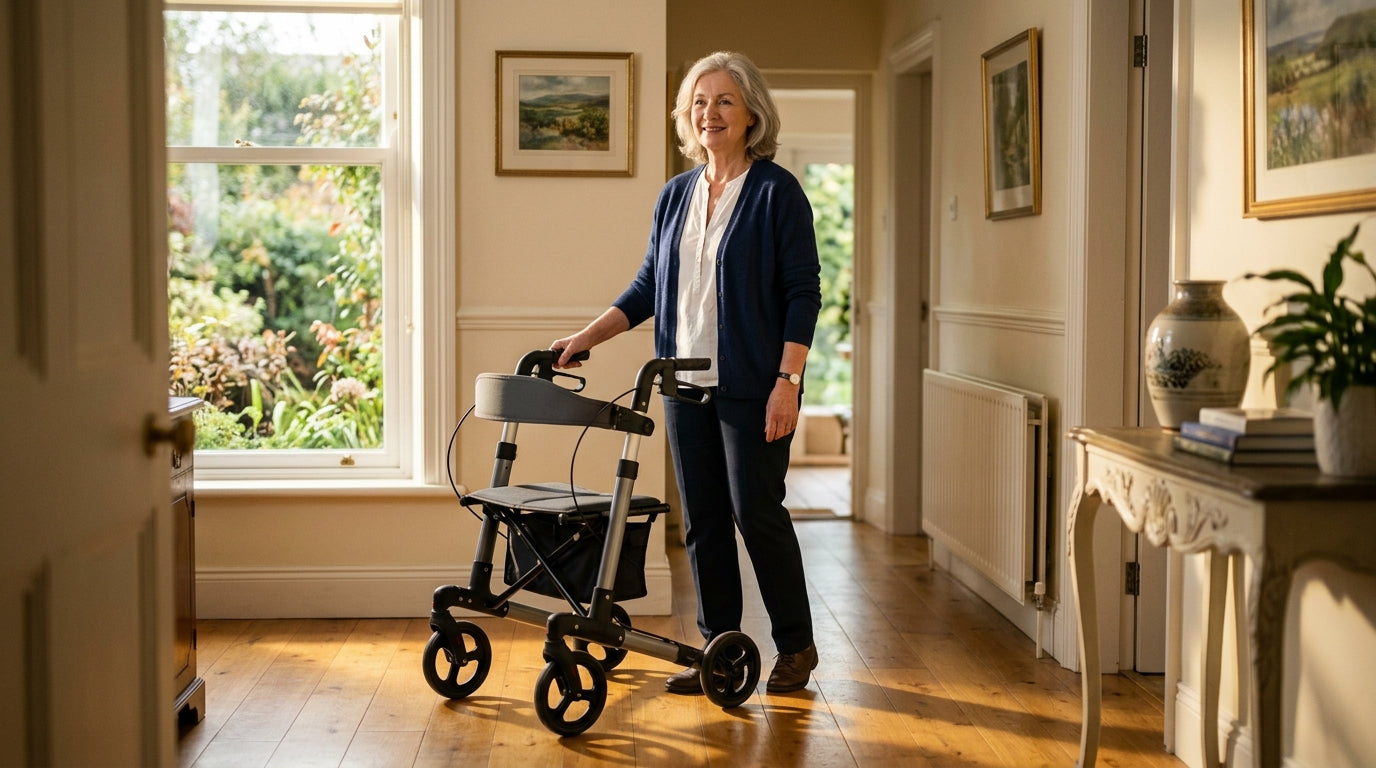
Choosing the right rollator can make a significant difference to everyday confidence, comfort, and independence. With so many models available — from lightweight aluminium frames to heavy-duty outdoor rollators — it can feel overwhelming to know where to begin. Whether you are browsing for yourself or researching on behalf of a family member, this guide will walk you through every key consideration so you can make a well-informed decision.
A rollator is not simply a walking frame with wheels. It is a carefully engineered mobility aid designed to provide steady, controlled support during movement. The right choice depends on a combination of physical requirements, lifestyle habits, and the environments in which it will be used. Getting this decision right means greater ease of movement day to day — and greater peace of mind for everyone involved.
At elderlycareproducts.ie, we stock a curated selection of rollators sourced from trusted suppliers, including the Timago range from Poland — known for robust build quality and ergonomic design. In this guide, we cover frame size, wheel configuration, braking systems, weight capacity, and the additional features worth paying attention to.
Understanding the Different Types of Rollators
Before diving into specific features, it helps to understand the broad categories of rollators available on the market. Each type is suited to different levels of activity and different environments.
Standard Three-Wheel Rollators
Three-wheel rollators are lightweight and highly manoeuvrable, making them well suited to indoor use and navigating narrower spaces such as hallways, shops, and bathrooms. They typically lack a seat, which keeps the frame compact and reduces overall weight. If the primary use case is light indoor navigation rather than extended outdoor walks, a three-wheel model may be ideal.
Four-Wheel Rollators
Four-wheel rollators offer greater stability than their three-wheel counterparts. They almost always include a padded seat and a storage basket or bag beneath it, making them practical for longer outings. The wider base provides a reassuring sense of balance, and the seat means the user can rest whenever needed — whether on a walk around the block or a trip to the shops. This is the most popular category for all-round everyday use.
Heavy-Duty and Bariatric Rollators
For users who require a higher weight capacity or a broader frame, heavy-duty and bariatric rollators provide reinforced construction without sacrificing core functionality. These frames are engineered to meet more demanding requirements while still offering the standard features — seat, basket, and adjustable handles — expected of a quality rollator.
Lightweight and Travel Rollators
Compact, foldable rollators designed for travel are increasingly popular. Models in this category — such as those in the byACRE collection — prioritise portability and ease of folding without compromising on stability. If the rollator will regularly be placed in a car boot or taken on public transport, weight and fold mechanism are critical factors.
You can explore the full range across all these categories by visiting our Rollators & Frames collection at elderlycareproducts.ie.
How to Choose the Right Rollator Size and Frame Fit
Correct sizing is one of the most important — and most frequently overlooked — aspects of choosing a rollator. An ill-fitting frame can cause poor posture, wrist strain, and reduced stability rather than improving it.
Handle Height Adjustment
The handles of a rollator should sit at approximately wrist height when the user stands upright with their arms relaxed at their sides. Most rollators offer adjustable handle heights within a set range, typically between 79 cm and 97 cm, though this varies by model. Always check the adjustment range before purchasing and ensure it accommodates the user's height comfortably.
Handles set too low cause the user to stoop forward, placing strain on the lower back and reducing overall balance. Handles set too high force the shoulders upward and can create tension through the arms and neck. Neither posture is comfortable or safe over extended use.
Frame Width and Indoor Clearance
Consider the width of doorways in the home. Standard interior doors in Irish homes are typically around 75–80 cm wide, but older properties may be narrower. Measure key doorways — particularly the bathroom, bedroom, and main living areas — before selecting a rollator. Most standard four-wheel rollators have a frame width of between 55 cm and 65 cm, but always confirm the specification.
User Weight Capacity
Every rollator has a stated maximum weight capacity. Standard models typically support up to 100–135 kg, while heavy-duty versions can accommodate considerably more. Always choose a rollator whose capacity provides a comfortable margin above the user's actual weight. Exceeding the stated capacity compromises both the structural integrity of the frame and the safety of the user.
Wheels, Terrain, and Outdoor Use
The wheel configuration of a rollator has a direct impact on how smoothly and safely it performs across different surfaces. This is an area where taking time to assess the user's typical environment pays real dividends.
Wheel Size Matters
Wheel diameter affects how easily the rollator rolls over uneven surfaces. Smaller wheels — typically 150 mm or less — are well suited to smooth indoor surfaces such as tiles, hardwood, and carpet. Larger wheels — 200 mm and above — handle outdoor terrain far more effectively, coping better with pavements, light gravel, and kerb edges.
If the rollator will be used both indoors and outdoors regularly, look for a model with medium-to-large wheels (around 180–200 mm) that strike a reasonable balance between indoor manoeuvrability and outdoor performance.
Wheel Type: Solid vs Pneumatic
Most rollators use solid rubber wheels, which require no maintenance and will never puncture. Pneumatic (air-filled) tyres provide a slightly softer ride on rough terrain but require occasional inflation. For most everyday users in Ireland, solid rubber wheels are the more practical choice — one less maintenance task to think about.
Assessing the Terrain
Think honestly about the surfaces the rollator will encounter most often:
- Smooth indoor floors: smaller wheels, narrower frame
- Outdoor pavements and paths: medium to large wheels, wider wheelbase for stability
- Mixed indoor and outdoor use: medium wheels with a locking seat for rest stops
- Travel and public transport: lightweight foldable frame, compact wheel size
Braking Systems: Safety and Control
A reliable braking system is non-negotiable. The brakes on a rollator serve two distinct purposes: slowing the rollator during movement, and locking it in place when the user sits down or pauses. Understanding the difference between these functions is essential when evaluating a model.
Loop Brakes vs Push-Down Brakes
The majority of rollators use loop brakes — similar in principle to bicycle brakes. Squeezing the brake levers engages resistance on the rear wheels, slowing the rollator gradually. Releasing them allows the wheels to roll freely again. Many loop brake systems also allow the brakes to be locked in the engaged position, so the rollator remains stationary when the user sits on the seat or steps away briefly.
Push-down brakes (sometimes called pressure brakes) are found on simpler walking frames rather than rollators. They activate when the user applies downward weight. While these can feel intuitive, they are generally less precise than loop brakes and are not typically found on four-wheel rollators.
Grip and Ease of Operation
Brake levers must be easy to squeeze and release without requiring significant hand strength. Look for ergonomic lever designs with a comfortable grip surface. If there is any concern about grip strength or dexterity — for example due to joint stiffness — test the brake mechanism carefully before purchasing, or look for models specifically designed with softer-action brakes.
Brake Adjustment and Maintenance
Quality rollators allow the brake cable tension to be adjusted. Over time, cables can stretch slightly, reducing braking effectiveness. Choose a model where this adjustment is straightforward, and check the brakes periodically as part of routine maintenance to ensure they remain responsive.
Seats, Storage, and Additional Features
Beyond the core structure, a number of additional features can significantly enhance the practical value of a rollator. These are worth considering carefully rather than treating them as afterthoughts.
The Padded Seat
A padded seat transforms a rollator from a walking aid into a genuinely versatile mobility companion. The ability to pause and rest during a walk — without needing to locate a bench — is a meaningful benefit for anyone who experiences fatigue or breathlessness during longer outings. Look for a seat that is firm enough to sit on safely (soft seats can compromise stability), padded for comfort, and at a height that makes sitting and standing straightforward.
Storage: Baskets and Bags
Most four-wheel rollators include a storage bag or basket beneath the seat. This is useful for carrying shopping, personal items, or a small bag during outings. Some models feature both a bag and a tray table — a practical addition for use at home. Consider how much storage capacity is genuinely needed and whether the bag is easy to remove for cleaning or replacement.
Foldability and Transport
If the rollator will need to be folded regularly — for car travel, storage at home, or use on public transport — check the fold mechanism carefully. The ideal mechanism folds quickly with minimal effort, ideally with a single cross-bar press or lift, and produces a compact footprint. Also check the folded dimensions against the boot space of the car most frequently used.
Accessories Worth Considering
Some rollators are compatible with optional accessories that extend their usefulness:
- Cup holders: useful for carrying a drink safely during indoor use
- Cane or crutch holders: for users who also use a walking stick
- Tray tables: practical for carrying items around the home
- Walking frame glides: protective tips for indoor floor surfaces
If accessories are important, confirm compatibility with the specific rollator model before purchasing rather than assuming they will fit universally.
Frequently Asked Questions About Choosing a Rollator
What is the difference between a rollator and a walking frame?
A walking frame (also called a Zimmer frame) is a static four-legged frame that must be lifted and repositioned with each step. A rollator has wheels, allowing it to roll smoothly as the user walks forward. Rollators typically also include a seat, brakes, and storage, making them more suitable for users who are mobile but want additional confidence and stability during movement.
How do I know what handle height I need?
Stand upright with your arms relaxed at your sides. The correct handle height is approximately level with your wrist. Most rollators offer an adjustable range — check that the range comfortably covers the user's height before purchasing. If the handles cannot be set to the correct height, the rollator will be uncomfortable and potentially unsafe to use.
Can rollators be used outdoors?
Yes, many rollators are designed for both indoor and outdoor use. For regular outdoor use, look for models with larger wheels (180 mm or above), a wider and more stable wheelbase, and reliable loop brakes. Lighter-duty models with small wheels are better suited to smooth indoor surfaces only.
What weight capacity should I look for?
Choose a rollator whose stated maximum weight capacity is comfortably above the user's actual weight — ideally by at least 15–20 kg. This ensures the frame performs as intended and provides a safety margin. Standard rollators typically support 100–135 kg; heavy-duty models are available for higher requirements.
How do rollator brakes work?
Most rollators use loop brakes operated by levers on the handles. Squeezing the levers applies friction to the rear wheels, slowing or stopping the rollator. The brakes can usually be locked in the engaged position to keep the rollator stationary when sitting on the seat or pausing on a slope. Brakes should be tested regularly and adjusted if they feel less responsive over time.
Are foldable rollators as sturdy as non-foldable ones?
Quality foldable rollators are designed to be just as sturdy as fixed-frame models during use. The fold mechanism is engineered to lock securely when the rollator is open and in use. Always ensure the rollator is fully unfolded and any locking mechanism is engaged before use. If in doubt, check with the supplier or consult the product manual.
Making Your Final Decision
Choosing the right rollator comes down to matching the specific features of a frame to the real-world needs of the person who will be using it. Start with the fundamentals — handle height range, weight capacity, and wheel size for the intended surfaces — and then consider the additional features that will make daily use genuinely comfortable and practical. There is no single 'best' rollator; there is only the right rollator for the individual circumstances.
At elderlycareproducts.ie, our rollator range is carefully selected to cover a broad range of requirements, from compact indoor models to robust outdoor frames and premium lightweight options. If you are ready to explore what is available, visit our Rollators & Frames collection to browse current stock, or take a look at our Best Sellers to see which models are most popular with our customers across Ireland.