
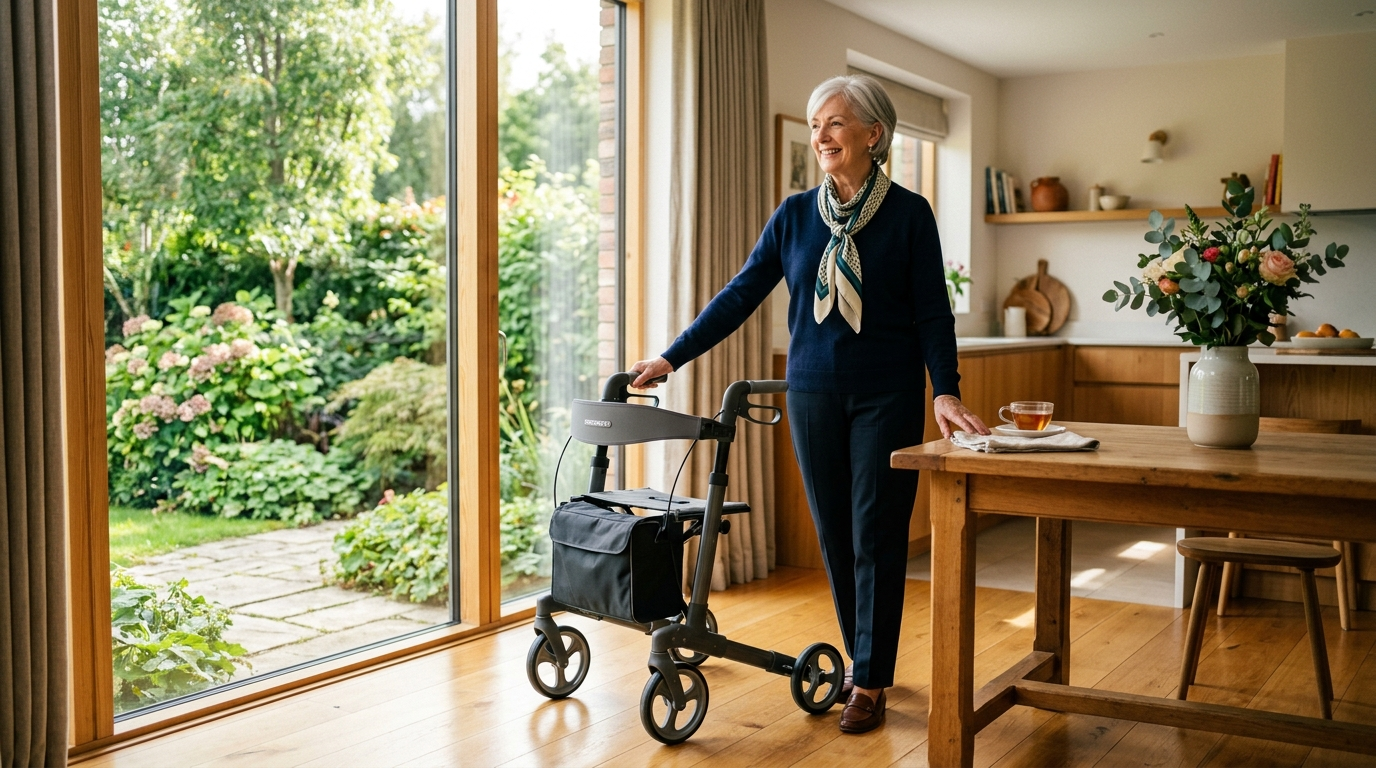
Finding the right walking aid can make an enormous difference to everyday confidence and independence. Whether you are looking for a straightforward walking stick for occasional support on uneven ground or a sturdy four-wheeled rollator for longer outings, the sheer variety of options available in Ireland can feel overwhelming. This guide is designed to cut through the noise and help you make an informed decision — covering everything from walking stick types and adjustability to the key features that separate a reliable walking frame from one that will leave you frustrated within weeks.
At elderlycareproducts.ie, we supply a carefully chosen range of walking aids from trusted European manufacturers, and we know from experience that the best walking sticks and frames in Ireland are not necessarily the most expensive — they are the ones that genuinely match the user's environment, grip strength, and daily routine. In this guide, we will walk you through every category, highlight the features worth paying for, and give you practical advice on sizing, safety, and maintenance.
Whether you are purchasing for yourself or helping a family member choose the right support, read on for Ireland's most comprehensive buyer's guide to walking sticks and frames in 2026.
Types of Walking Sticks and Frames Available in Ireland
The term "walking aids" covers a surprisingly wide spectrum of products. Understanding the differences between them is the essential first step in making the right choice. Here is a breakdown of the main categories you will encounter when shopping for the best walking sticks and frames in Ireland.
Standard Walking Sticks
The classic single-point walking stick is the most familiar option. Available in wood, aluminium, and carbon fibre, a good walking stick provides light lateral support and helps redistribute a portion of body weight away from a painful joint or weaker leg. Adjustable aluminium sticks are the most practical everyday choice — lightweight, rust-resistant, and easy to set to the correct height. Folding walking sticks are ideal for travel or situations where you need to put the stick away quickly, such as when sitting in a restaurant or getting into a car.
Tripod and Quad Sticks
Tripod sticks have three feet at the base, while quad sticks (also called four-point sticks) have four. Both offer significantly greater stability than a single-point stick, and crucially, they can stand upright on their own — a practical advantage when you need both hands free. These walking sticks are particularly well-suited to uneven surfaces and situations where balance support is the primary concern rather than simply reducing joint load.
Walking Frames (Zimmer Frames)
A standard walking frame — often still called a Zimmer frame in Ireland — is a lightweight tubular frame with four legs and no wheels. The user lifts and places the frame forward with each step. This style offers maximum stability and is often recommended for post-surgical recovery or situations where a slower, more deliberate gait is appropriate. The main drawback is that they require a two-handed lift with each step, which can be tiring over longer distances.
Two-Wheeled Walkers
Two-wheeled walkers add a wheel to each of the front two legs, allowing the frame to roll forward smoothly without needing to be lifted entirely off the ground. This makes them faster and less tiring to use than a standard frame, while still providing a high degree of stability. The rear two legs have rubber ferrules that create gentle friction to prevent the walker rolling away unintentionally. These are a popular choice for indoor use in Irish homes.
Three-Wheeled Rollators
Three-wheeled rollators are lighter and more manoeuvrable than their four-wheeled counterparts, making them well-suited to navigating narrow corridors, shops, and public transport. They typically include a hand brake and a small bag or basket for carrying personal items. However, because they do not have a seat, they are best suited to those who need primarily movement assistance rather than rest stops during longer walks.
Four-Wheeled Rollators
The four-wheeled rollator is arguably the most versatile walking frame on the market, and it represents the majority of our sales at elderlycareproducts.ie. Most models include a padded seat, a backrest, lockable hand brakes, and a storage bag or basket beneath the seat. Four-wheeled rollators allow for a natural walking pace and are suitable for both indoor and outdoor use. Premium models feature larger puncture-resistant wheels for outdoor terrain, ergonomic handles, and foldable frames for easy transport in a car boot.
If you are weighing up your options in this category, you can browse our full rollator and walking frame range at elderlycareproducts.ie to compare models, dimensions, and weight capacities side by side.
Key Features to Look for in the Best Walking Sticks and Frames
Once you have identified the right category of walking aid, the next step is evaluating specific features. Not all walking sticks and frames are built to the same standard, and the details genuinely matter for long-term comfort and safety.
Adjustable Height
Correct handle height is one of the most important factors in both comfort and effectiveness. A walking stick or frame set too high will cause shoulder strain; too low and you will hunch forward, placing unnecessary strain on the lower back. As a general rule, the handle should be at wrist height when you stand upright with your arms relaxed at your sides. Look for products with tool-free push-button height adjustment — this makes it easy to fine-tune the fit or share the aid between users of different heights.
Handle and Grip Design
The grip is your primary point of contact with the walking aid, and a poorly designed handle can cause discomfort in the hand, wrist, or forearm over time. Ergonomic handles with a contoured shape distribute pressure more evenly across the palm. Foam or rubberised coatings improve grip in wet conditions — a particularly relevant consideration given Irish weather. Some rollators offer height-adjustable and angle-adjustable handles independently, allowing for a personalised fit.
Braking Systems on Rollators
For four-wheeled rollators, the braking system is a critical safety feature. Look for loop brakes (also called push-down brakes) that operate intuitively — squeezing the handles to slow the rollator, and pushing them down to lock the brakes when seated or stationary. Check that the brake cables are sturdy and that the brake mechanism can be operated comfortably with the level of grip strength available to the user.
Weight and Portability
Heavier frames offer more structural rigidity but can be cumbersome to lift into a car or carry upstairs. If portability is a priority — for example, if the user travels regularly or uses the aid primarily outdoors — look for aluminium or carbon fibre models that fold compactly. Most quality rollators fold laterally with a single central handle, making them straightforward to place in a car boot. Standard weights for aluminium rollators range from approximately 5 kg to 8 kg.
Wheel Size and Surface Compatibility
Smaller wheels (typically 150 mm–175 mm) are well-suited to smooth indoor surfaces. Larger wheels (200 mm or above) handle outdoor terrain, kerbs, and gravel paths more comfortably. If the walking frame will be used primarily indoors, smaller wheels and a narrower frame width are preferable. For mixed indoor and outdoor use — including gardens, car parks, and Irish footpaths — a four-wheeled rollator with larger, slightly wider wheels is the more practical investment.
Weight Capacity
Every walking frame and rollator has a stated maximum user weight. Most standard models support between 100 kg and 130 kg, while heavy-duty or bariatric models accommodate up to 180 kg or more. Always verify the weight capacity before purchasing, as exceeding it will compromise both safety and the structural longevity of the frame.
Choosing the Right Walking Aid for Your Situation
Selecting from the best walking sticks and frames in Ireland ultimately comes down to an honest assessment of three factors: the level of support required, the primary environments in which the aid will be used, and the practical lifestyle of the person using it. Here is how to approach that decision.
Level of Support Required
- Light, occasional support: A standard adjustable walking stick is sufficient for those who need a little extra confidence on uneven ground or during longer walks.
- Balance and stability support: A quad stick, two-wheeled walker, or three-wheeled rollator offers more reliable lateral stability for those who experience balance fluctuations.
- Comprehensive everyday support: A four-wheeled rollator with a seat and brakes is the most versatile option for those who need consistent support throughout the day, including the ability to rest during outings.
- Post-operative or high-dependency support: A standard lifting frame or wheeled walker may be more appropriate following surgery or a period of reduced mobility, particularly where a physiotherapist or occupational therapist has made a specific recommendation.
Primary Environment of Use
- Primarily indoors: Prioritise a narrower frame width to navigate standard Irish doorways (typically 750 mm–820 mm clear), lighter weight, and smaller wheels for smooth floors.
- Primarily outdoors: Look for larger wheels, a sturdier frame, and weather-resistant materials. Rollators from our Timago range are particularly well-regarded for mixed-terrain outdoor use.
- Frequent travel: A folding rollator or a lightweight folding walking stick that fits into luggage is a worthwhile investment for those who travel by car, bus, or air regularly.
Practical Lifestyle Considerations
Consider how the walking aid will fit into daily life beyond simple mobility. Does the user need to carry shopping, medication, or personal items? A rollator with a storage bag or basket is invaluable for this. Does the user spend extended periods on their feet? A rollator with a padded seat allows for rest stops without needing to find a bench. Is the aid likely to be used in social settings such as shops, cafés, or community centres? A sleek, modern-looking design in a neutral colour can help the user feel confident rather than self-conscious.
Safety Tips for Using Walking Sticks and Frames
Even the best walking stick or frame will only perform well if it is used correctly and maintained regularly. Here are the most important safety considerations to keep in mind.
Correct Height and Posture
As noted above, handle height matters enormously. Walk upright with a slight forward lean — do not lean heavily on the frame or slouch over it, as this places strain on the lower back and reduces the stability of the aid itself. If pain, fatigue, or discomfort persists during use, it is worth consulting a physiotherapist or occupational therapist for a professional assessment.
Ferrule Maintenance
The rubber ferrules (caps) on the base of walking sticks and walking frames are the primary point of contact with the floor and the main source of grip and slip resistance. Worn ferrules reduce traction dramatically, particularly on wet or smooth surfaces — a genuine hazard on Irish pavements. Check ferrules regularly for wear and replace them promptly when the rubber shows signs of cracking, flattening, or reduced grip. Replacement ferrules are inexpensive and widely available.
Brake Cable Checks on Rollators
For rollator users, check the brake cables and brake pads every few months. Cables can stretch over time, reducing braking efficiency. If the brakes feel less responsive or require more handle pressure than usual, have them adjusted or replaced before continuing to use the rollator outdoors.
Folding and Locking Mechanisms
Before each use, confirm that any folding mechanisms are fully locked and that push-button height adjusters are properly engaged. A frame that collapses unexpectedly mid-use is a significant fall risk. Make it part of the daily routine to give the frame a gentle push-test before relying on it.
Flooring Hazards at Home
At home, remove loose rugs or secure them with non-slip backing, ensure cables and clutter are cleared from walkways, and consider the transition between different flooring surfaces. Walking frames can catch on door thresholds, so it is worth checking that these are flush or ramped where possible.
For users who would benefit from additional joint support alongside their walking aid, our joint supports collection includes a range of braces and supports for the knee, wrist, and ankle that complement the use of walking frames and sticks.
Frequently Asked Questions: Walking Sticks and Frames in Ireland
What is the difference between a rollator and a walking frame?
A standard walking frame (sometimes called a Zimmer frame) has four fixed legs and must be lifted and placed forward with each step. A rollator has wheels — either three or four — and rolls forward as you walk, eliminating the need to lift the frame. Rollators also typically include hand brakes, a seat, and storage, making them more versatile for longer outings. Walking frames tend to offer slightly more stability for very slow or careful walking, while rollators suit a more active, everyday lifestyle.
How do I know what height to set my walking stick or frame?
Stand upright with your arms relaxed at your sides. The handle of your walking stick or frame should align with your wrist joint. When holding the handle, your elbow should be slightly bent — approximately 15–20 degrees — rather than fully straight. Most adjustable models allow height changes in increments of approximately 25 mm, so you should be able to dial in a comfortable fit precisely.
Are rollators suitable for outdoor use on Irish footpaths?
Yes, provided you choose a model with appropriately sized wheels. Rollators with wheels of 200 mm or larger handle typical Irish footpaths, dropped kerbs, and light gravel paths comfortably. Smaller-wheeled indoor models may struggle with uneven surfaces or kerb edges. Always check the wheel size specification before purchasing if outdoor use is a priority.
How often should I replace the ferrules on my walking stick?
There is no fixed schedule, as wear depends on frequency of use and surface type. As a guideline, inspect ferrules monthly. Replace them immediately if the rubber appears cracked, flat, or shiny on the base — a smooth ferrule provides minimal grip, especially on wet surfaces. Replacement ferrules are inexpensive and can usually be fitted at home without tools.
Can I bring a rollator on public transport in Ireland?
Most folding rollators can be taken on Irish Rail, Dublin Bus, and Bus Éireann services, though it is advisable to fold the rollator where possible during busy periods. Many Irish Rail stations have level boarding or portable ramps available. Contact the relevant transport operator in advance if you are planning a longer journey, as facilities vary by route and station.
Do walking frames and rollators come with a warranty?
Yes — all walking aids sold through elderlycareproducts.ie come with a manufacturer's warranty. Specific warranty periods vary by brand and model. Products supplied through our Timago range are covered by the manufacturer's standard warranty, and our customer support team can assist with any warranty queries or replacement parts.
Conclusion
Choosing the best walking stick or frame in Ireland does not need to be complicated, but it does deserve careful thought. The right walking aid — correctly fitted, well-maintained, and matched to your daily environment — supports confident, independent movement in a way that makes a genuine positive difference to everyday life. From a simple adjustable walking stick for occasional use to a fully featured four-wheeled rollator with a padded seat for all-day support, the options available in 2026 are better than ever in terms of quality, design, and value.
At elderlycareproducts.ie, we are committed to helping people across Ireland find walking aids that genuinely work for them. Our range is carefully selected for quality, durability, and practicality — and our team is always available to answer questions and guide you to the right choice. Explore our full rollators and walking frames collection at elderlycareproducts.ie and take the first step towards greater everyday confidence.