
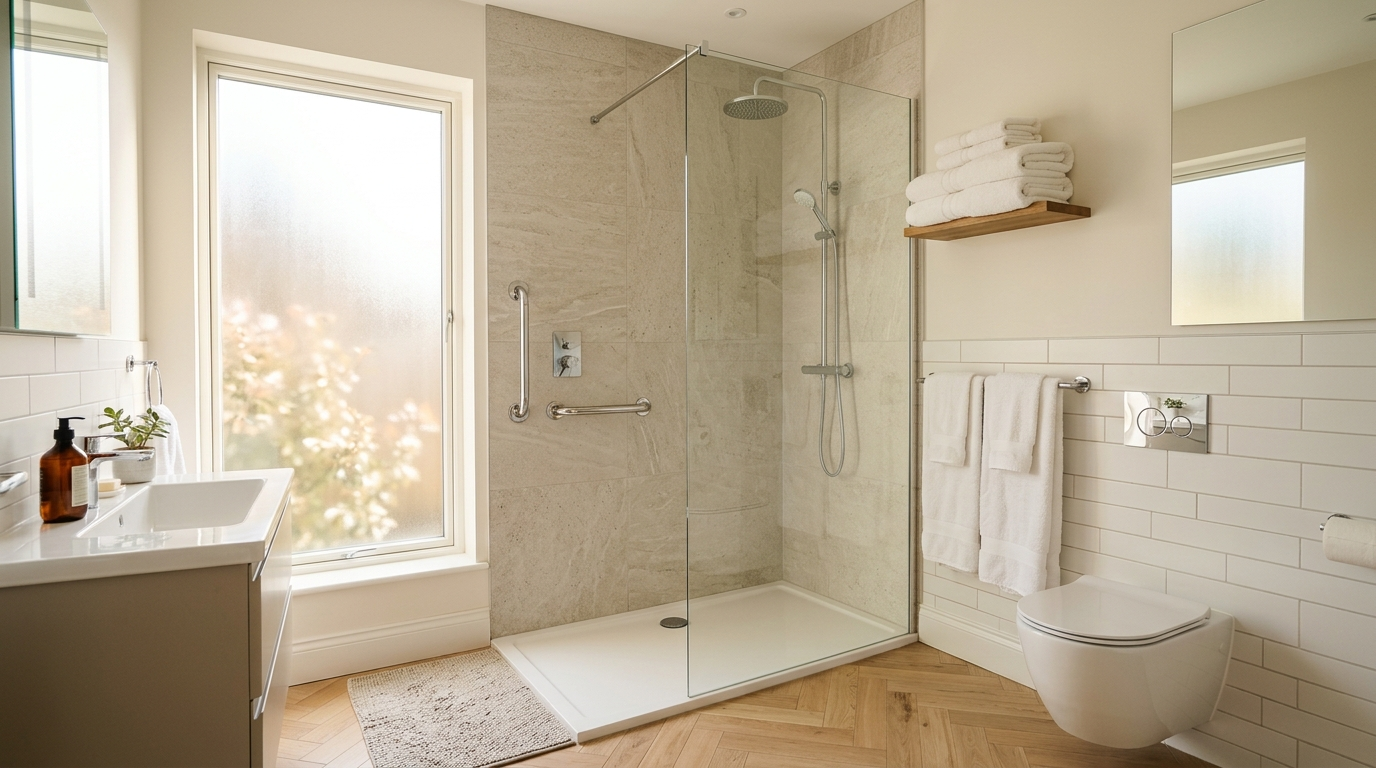
The bathroom is one of the most important rooms in the home to get right when it comes to stability and support. Wet surfaces, confined spaces, and the need to shift positions frequently all create situations where a well-placed grab rail can make an enormous difference to confidence and safety. Whether you are adapting a family home, supporting a loved one who lives alone, or simply planning ahead, choosing the right grab rail for an Irish bathroom takes more thought than many people expect.
From wall-mounted stainless steel bars to fold-down shower seats with integrated support handles, the market has expanded significantly in recent years. Yet with so many options available — and so much variation in quality, weight capacity, and installation requirements — it can be genuinely difficult to know where to begin. This guide cuts through the noise, covering every key consideration so you can make a confident, well-informed purchase.
At elderlycareproducts.ie, we work with trusted suppliers to bring practical, durable bathroom aids to homes across the Republic of Ireland. Read on for everything you need to know about finding the best grab rails for bathrooms in Ireland.
Why Grab Rails Matter in the Bathroom
It is easy to underestimate how physically demanding a typical bathroom routine can be. Stepping over a bath edge, lowering into a shower tray, or rising from a toilet all require a brief but significant transfer of weight and balance. On a dry surface with plenty of space, most people manage these transitions without a second thought. Add water, steam, and a smaller footprint, and the risk of an unsteady moment increases considerably.
Grab rails address this directly. By giving a fixed, reliable point of contact at exactly the right moment in a movement, they allow a person to distribute effort more evenly and maintain control throughout. The result is not just safer movement — it is more confident, more independent movement. Users who might otherwise hesitate or avoid certain bathroom tasks entirely often find that a well-positioned grab rail restores their willingness to manage their routine without assistance.
The Difference Between a Grab Rail and a Towel Rail
This distinction matters more than people often realise. Standard towel rails, decorative bars, and soap dish holders are not designed to bear sudden lateral or downward force. They are typically fixed with smaller, shallower fixings into plasterboard or tile adhesive alone. A grab rail, by contrast, is engineered specifically to withstand dynamic load — that is, the kind of force generated when someone grabs it quickly to steady themselves. Dedicated grab rails use reinforced wall fixings, heavier-gauge materials, and tested weight ratings. Never substitute a towel rail for a grab rail.
Types of Grab Rails for Bathrooms
Understanding the main categories of grab rails available in Ireland will help you match the right product to the right location and need. Each type suits a slightly different situation, so it is worth familiarising yourself with the full range before committing to a purchase.
Fixed Wall-Mounted Grab Rails
These are the most common and most reliable option for long-term home adaptations. Fixed rails are bolted directly into wall studs or solid masonry using appropriate fixings, creating a permanently stable point of support. They are available in a wide range of lengths — typically from 30 cm to 90 cm — and can be installed horizontally, vertically, or at an angled position depending on where support is most needed.
- Horizontal rails are best positioned beside the toilet or along the length of a bath, allowing the user to push or pull sideways as they rise or lower themselves.
- Vertical rails work well at bath entry and exit points, giving something to grip as the body moves up and down rather than side to side.
- Angled rails (typically at 30–45 degrees) are often the most ergonomic option because they accommodate both the initial downward grip and the upward push-off in a single bar.
Fold-Down or Swing-Away Rails
Fold-down rails are hinged so they can be swung up flush against the wall when not in use. This is a practical solution in smaller Irish bathrooms where floor space and freedom of movement matter. When needed, the rail folds down into a horizontal or angled position. They are particularly popular beside toilets and in wet rooms. Quality matters here — look for fold-down rails with a positive locking mechanism in both the open and closed positions.
Floor-to-Ceiling Poles
These tension-mounted poles require no wall fixings at all, making them suitable for rented properties or tiled walls where drilling is not desirable. They wedge securely between floor and ceiling using an adjustable mechanism. While not a permanent structural adaptation, a quality floor-to-ceiling pole can provide meaningful support beside a toilet or at a bath entry point. They should always be checked for tension regularly.
Bath-Side Rails and Grab Handles
These clip or clamp onto the rim of a standard bath without any wall fixing required. They provide a vertical grip for stepping in and out of the bath. Because they rely on the bath rim for support, they are best suited to situations where wall mounting genuinely is not possible. Always verify the weight rating and ensure the clamp is compatible with the bath profile before purchasing.
Suction Cup Grab Rails
Suction cup rails attach to smooth, non-porous tiles or glass surfaces without any drilling. They are portable and easy to reposition, which makes them a convenient travel option. However, suction cup rails should never be treated as a primary safety aid in a fixed home setting. Surface contamination, moisture, and ageing suction pads can all reduce grip without warning. They are best considered a supplementary or temporary solution only.
Key Factors to Consider When Choosing a Grab Rail in Ireland
Once you understand the types available, there are several practical considerations that will narrow your choice further. Getting these right ensures the rail you purchase will actually perform as needed once installed.
Weight Rating
Every grab rail should carry a clearly stated maximum load capacity. For a primary support rail, look for a minimum rating of 120 kg, though rails rated to 150 kg or higher offer a greater safety margin. Always cross-reference the weight rating against the fixing type — a rail rated to 150 kg loses that rating if installed with incorrect or undersized fixings.
Material and Finish
Stainless steel and chrome-plated steel are the most durable and hygienic options for bathroom environments. They resist corrosion, are easy to clean, and maintain structural integrity over years of use. Nylon-coated or textured rails offer improved grip even with wet hands, which is a meaningful practical advantage in a shower or bath setting. Avoid rails with plastic structural components — these may look similar at first glance but will not offer equivalent strength or longevity.
Length and Positioning
The correct length of grab rail depends on its intended position and the movement it needs to support. A rail placed beside a toilet typically needs to be long enough to be gripped both during the downward sit and the upward rise — usually at least 60 cm. A rail at a bath entry point may only need to provide a single vertical grip, making a shorter 30–45 cm bar perfectly adequate. Think through the full sequence of movement before choosing a length.
Fixing Method and Wall Construction
Irish homes vary considerably in wall construction. Older properties often have solid plaster over masonry — an excellent fixing substrate. Newer builds may use plasterboard stud walls, which require specialist toggle fixings or, ideally, fixing into studs. Tiled walls add another layer of complexity, as drilling through tiles risks cracking without the correct technique and drill bit. If you are unsure about your wall construction, engaging a qualified handyperson or occupational therapist for the installation is strongly recommended.
Installation: Professional vs DIY
While some grab rails are marketed as easy DIY installations, the consequences of a poorly fitted rail are serious enough to warrant careful consideration. A rail that pulls away from the wall under load provides a false sense of security that is potentially worse than no rail at all. For permanent, load-bearing installations in primary bathrooms, professional installation by someone familiar with grab rail requirements is the safest approach. In Ireland, the Housing Adaptation Grant for People with a Disability — administered by local authorities — may cover both the cost of the rail and its professional installation. It is always worth enquiring with your local county council.
Where to Position Grab Rails in an Irish Bathroom
Strategic placement is as important as the rail itself. A grab rail in the wrong position provides little benefit and may even encourage an awkward body position that increases rather than reduces strain. The following positions are the most commonly recommended by occupational therapists and home adaptation specialists.
Beside the Toilet
Rising from and lowering onto the toilet requires a combination of leg strength and balance. A horizontal or angled rail positioned at approximately seat height on the dominant side provides something to push against during the upward phase of the movement. Where space allows, rails on both sides offer the most balanced support. The rail should be positioned so the elbow remains slightly bent when gripping — this allows effective push-off force without overextension.
Shower Entry and Interior
A vertical rail at the entry point of a shower cubicle helps with the step in and out. Once inside, a second rail — either horizontal or angled — on the side wall supports the user during washing, particularly when standing on one leg to wash a foot. In a wet room without a physical threshold, a rail near the showerhead position provides stability while adjusting temperature or directing the spray.
Bath Entry and Exit
Stepping over a bath rim is one of the most physically demanding bathroom movements. A vertical rail fixed to the wall at the head end of the bath helps with the initial entry step. A second rail on the long wall, positioned mid-bath, assists with lowering down and rising back up from a seated position. Consider a bath board or bath seat alongside rails to reduce the depth of the transfer required.
General Movement Through the Bathroom
In a compact Irish bathroom, a continuous rail along one or more walls can allow a person to move steadily from the door to the toilet to the shower without needing to release their grip. This approach is particularly effective in wet rooms or where the bathroom has been comprehensively adapted for full independent use.
Frequently Asked Questions About Grab Rails for Bathrooms in Ireland
Are grab rails covered by any grant scheme in Ireland?
Yes. The Housing Adaptation Grant for People with a Disability, administered by local county councils across Ireland, can cover the cost of grab rail installation as part of a broader home adaptation. The grant covers up to 95% of approved costs depending on household income. Contact your local authority directly to begin an application — an occupational therapy assessment is typically required as part of the process.
What is the recommended height for a grab rail beside a toilet?
The centre of a horizontal toilet grab rail is typically positioned between 75 cm and 85 cm from the floor — broadly at seat height. However, the optimal position varies with individual height and reach. An occupational therapist can assess the correct height for a specific person, and this is particularly valuable if the rail is intended as the primary daily support aid.
Can grab rails be fitted to tiled bathroom walls?
Yes, but it requires care. Drilling through ceramic or porcelain tiles without the correct technique risks cracking. Use a diamond-tipped drill bit, tape over the tile surface to reduce slipping, and drill at slow speed without hammer action through the tile itself. Once through the tile, switch to the appropriate bit for the wall material beneath. If in any doubt, engage a professional installer.
How do I know if my wall can support a grab rail?
Solid masonry walls — common in older Irish properties — can accept standard masonry fixings and will support a correctly rated grab rail without issue. Plasterboard stud walls require either specialist toggle bolts or fixing directly into the timber stud behind the board. Tapping the wall produces a noticeably hollow sound over plasterboard versus a dull, dense sound over masonry. If unsure, a qualified tradesperson can assess and advise before any drilling begins.
What is the difference between a grab rail and a support rail?
The terms are often used interchangeably in everyday language, but in product specifications, "grab rail" and "support rail" both refer to fixed aids designed to bear body weight. The key distinction worth checking is always the load rating and fixing specification — not the name on the packaging. Ensure any rail you purchase, regardless of what it is called, carries a clearly stated weight capacity appropriate for its intended use.
Is a suction grab rail safe for regular use?
Suction rails can be a convenient temporary or travel solution, but they are not recommended as a primary support aid in a fixed home setting. The suction bond can weaken over time, particularly in damp conditions, and may release without warning. For regular daily use, a wall-mounted rail with mechanical fixings is always the safer choice.
Conclusion
Finding the best grab rails for bathrooms in Ireland is ultimately about matching the right product to the right location, the right wall type, and the right pattern of daily use. A well-chosen, correctly installed grab rail does not just reduce the risk of an unsteady moment — it actively supports confident, independent movement through a routine that should feel manageable, private, and dignified. From fixed wall-mounted bars to fold-down shower rails, the options available in 2026 are better than ever, and the right choice for your bathroom is within reach.
At elderlycareproducts.ie, we are committed to helping Irish households find practical, high-quality mobility and independent living aids. Explore our full range of products and find the right solution for your home today.
Browse all mobility and independent living aids at elderlycareproducts.ie