
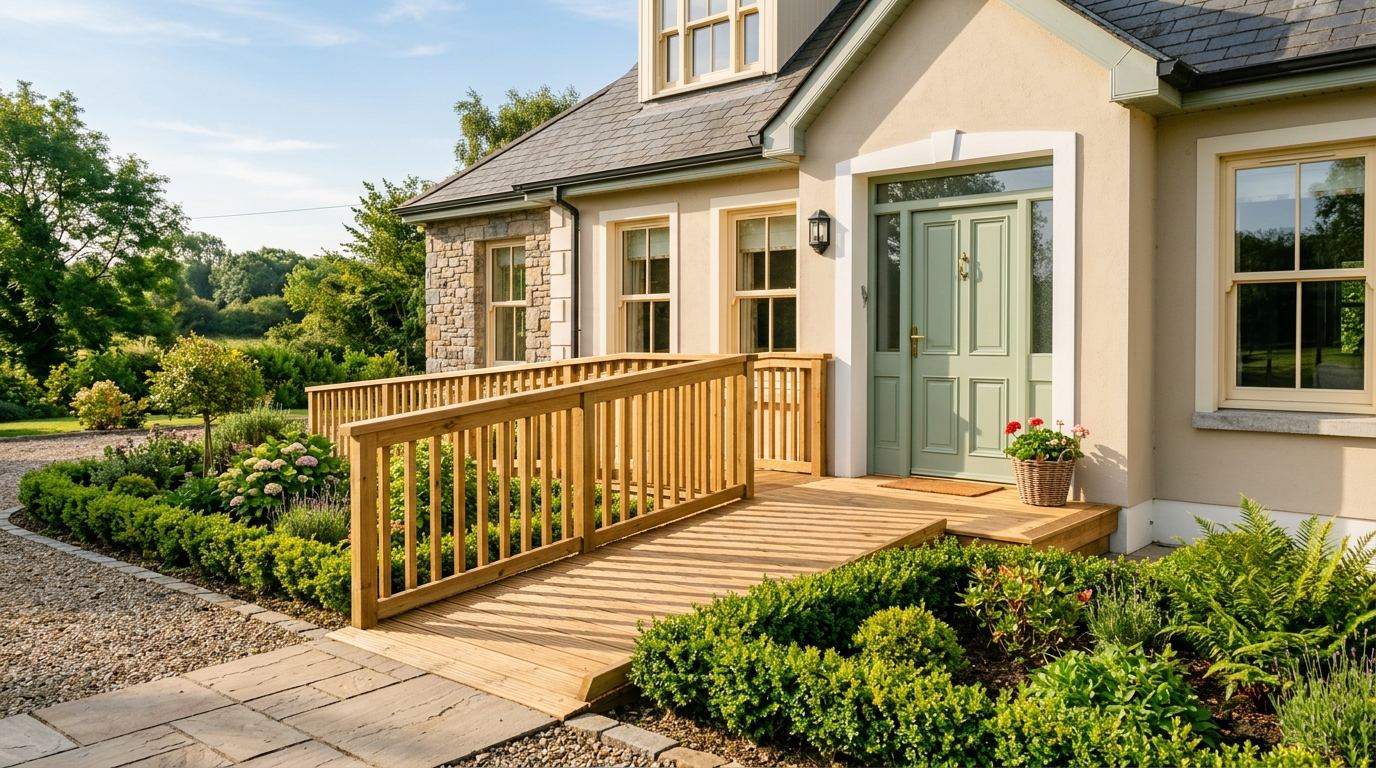
Making a home safer, more accessible, and easier to navigate is one of the most meaningful investments a household can make. For many families across Ireland, the Housing Adaptation Grant provides vital financial support to carry out those changes — covering everything from stairlift installation to the widening of doorways. Yet despite being one of the most generous publicly funded home improvement schemes in the country, many eligible households are unaware of exactly what it covers or how to access it.
The Housing Adaptation Grant for People with a Disability is administered by local authorities across the Republic of Ireland and is means-tested, with grants of up to €30,000 available depending on circumstances. It sits alongside two related schemes — the Mobility Aids Grant and the Housing Aid for Older People Grant — forming a trio of supports designed to help people remain living safely and comfortably in their own homes.
This guide breaks down what the Housing Adaptation Grant Ireland covers, who qualifies, how the application process works, and how assistive equipment from elderlycareproducts.ie can complement any home adaptation project.
What Is the Housing Adaptation Grant Ireland?
The Housing Adaptation Grant is a local authority scheme funded jointly by the Department of Housing, Local Government and Heritage and individual county and city councils. Its purpose is to fund necessary structural changes to a home so that a person with a disability or long-term health condition can continue to live there independently and safely.
Unlike a general home improvement grant, this scheme is specifically tied to a assessed need — meaning the works funded must be directly related to improving access, safety, or functional living for the person in question. An occupational therapist (OT) assessment is typically required as part of the application, and their report will heavily influence what works are approved.
How Much Funding Is Available?
The maximum grant available under the Housing Adaptation Grant is €30,000, which covers up to 95% of the approved cost of works. The percentage covered depends on household income:
- Households with a gross annual income of up to €30,000: grant covers up to 95% of approved costs
- Income between €30,001 and €50,000: grant covers a reduced percentage on a sliding scale
- Income above €50,000: households are not eligible for this particular grant
It is worth noting that the income threshold is assessed on a combined household basis. Your local authority housing department can clarify the exact calculation used in your county.
Who Administers the Grant?
The grant is administered through your local authority — for example, Dublin City Council, Cork County Council, Galway City Council, and so on. You apply directly to your local authority, and they carry out the assessment and approval process. Waiting times and processing speeds vary by county, so it is advisable to apply as early as possible.
What Works Does the Housing Adaptation Grant Cover?
This is the most important question for anyone considering an application. The Housing Adaptation Grant covers a broad range of structural and accessibility works, provided they are deemed necessary by the occupational therapist assessment and approved by the local authority.
Access and Mobility Adaptations
- Stairlift installation — one of the most commonly funded works under the scheme
- Ramp construction — external or internal ramps to replace steps
- Widening of doorways — to accommodate wheelchairs or walking frames
- Level-access shower installation — replacing a bath or standard shower with a walk-in or wet-room style unit
- Grab rail and handrail fitting — including staircase handrails and bathroom support rails
- Accessible bathroom adaptation — full bathroom reconfiguration where needed
Structural and Room-Change Works
- Extension of the home — to create a ground-floor bedroom or bathroom where stairs cannot be safely used
- Bedroom relocation — converting a ground-floor room to serve as a sleeping space
- Ceiling hoist track installation — for homes where a person requires assisted transfers
- Accessible kitchen modifications — lowered worktops, accessible storage, and similar adaptations
What Is Not Covered
It is equally important to understand what falls outside the scope of the Housing Adaptation Grant:
- General home repairs or cosmetic improvements unrelated to accessibility
- Works already completed before the grant was approved
- Standard home security installations not linked to assessed need
- Equipment such as rollators, wheelchairs, or mobility aids (these are separate products purchased independently)
While mobility aids and assistive equipment are not covered under this grant, they are an essential complement to any home adaptation project. Explore our rollators and walking frames or wheelchair range at elderlycareproducts.ie to find the right equipment for your home setup.
The Two Related Grants You Should Know About
The Housing Adaptation Grant sits within a wider framework of three local authority housing grants. Depending on your circumstances, you may be eligible for one or more of these schemes simultaneously — though you cannot claim overlapping costs from multiple grants for the same works.
The Mobility Aids Grant
The Mobility Aids Grant is a faster, simpler scheme aimed at households with a gross income of €30,000 or less. It funds basic works to address mobility difficulties in the home, up to a maximum of €6,000, covering 100% of approved costs. Typical works include grab rail installation, stair rails, and minor bathroom adaptations. Because it requires less documentation than the full Housing Adaptation Grant, it can be processed more quickly.
The Housing Aid for Older People Grant
This grant supports essential repairs and improvements to the homes of people aged 66 and over, with a maximum award of €8,000 (covering up to 95% of costs for lower-income households). Works covered include roof repairs, window replacement, plumbing and electrical upgrades, and insulation. While not exclusively an accessibility grant, many applicants use it in conjunction with the Housing Adaptation Grant to carry out a broader programme of home improvements.
How to Apply for the Housing Adaptation Grant in Ireland
The application process involves several steps, and it is worth preparing your documentation carefully before submitting. Incomplete applications are a common cause of delays.
Step 1: Get an Occupational Therapist Assessment
For most applications under the Housing Adaptation Grant, a report from a qualified occupational therapist is required. This assessment identifies the specific difficulties experienced in the home and recommends the works needed to address them. You can access this through the HSE (which may involve a waiting list) or arrange a private OT assessment, the cost of which may also be partially reclaimable in some circumstances — check with your local authority.
Step 2: Obtain Quotes from Contractors
You will typically need at least two written quotes from contractors for the proposed works. All contractors must hold valid tax clearance certificates (or equivalent tax compliance documentation). Your local authority may also have a list of approved contractors in your area.
Step 3: Complete the Application Form
Application forms are available from your local authority housing department or, in many cases, downloadable from their website. You will need to provide:
- Proof of ownership or tenancy of the property
- Proof of identity and PPSN
- Proof of household income (e.g. P60, payslips, or social welfare correspondence)
- The occupational therapist report
- Contractor quotes
- Planning permission (if required for the works)
Step 4: Await Assessment and Approval
Your local authority will assess the application, inspect the property if necessary, and issue a decision. If approved, works should not begin until you receive written approval — starting works before approval is a common reason applications are disqualified. Once works are complete, you submit invoices and your local authority arranges payment directly to you or your contractor.
Practical Tips for a Successful Application
Navigating a grant application can feel complex, but a few practical steps can make the process considerably smoother.
Apply Early
Local authority budgets for these grants are finite and allocated on a first-come, first-served basis in many counties. Applying early in the calendar year increases your chance of approval within that funding cycle.
Use a Private OT if Waiting Lists Are Long
HSE occupational therapy waiting lists can be lengthy in some areas. If urgency is a concern, commissioning a private OT report can significantly speed up the process. Costs typically range from €150 to €300, and some local authorities will factor this into the overall approved costs.
Keep Communication in Writing
Always correspond with your local authority in writing or by email so you have a clear record of communications, decisions, and timelines. This is particularly useful if there are delays or if you need to appeal a decision.
Plan Complementary Equipment Alongside Structural Works
While your grant application is being processed, it is a good time to consider what assistive equipment will best complement the planned adaptations. A level-access shower, for example, works best alongside a suitable shower chair or grab rail — and a widened doorway is most useful when paired with the right mobility aid. Browse our best-selling mobility products at elderlycareproducts.ie for inspiration.
Frequently Asked Questions
Can I apply for the Housing Adaptation Grant as a tenant?
Yes, private tenants can apply for the Housing Adaptation Grant, but you will need written consent from your landlord confirming they agree to the proposed works being carried out. Social housing tenants should contact their local authority or approved housing body directly, as different arrangements may apply.
Can the Housing Adaptation Grant be used alongside other grants?
Yes, in many cases you can access more than one grant scheme for a single property, provided the costs do not overlap. For example, it is possible to receive the Housing Aid for Older People Grant for repair works and the Housing Adaptation Grant for accessibility modifications at the same time. Your local authority housing officer can advise on your specific situation.
How long does the application process take?
Processing times vary considerably by local authority and by the complexity of the application. Straightforward applications with a complete set of documentation can be processed in as little as four to eight weeks. More complex cases involving planning permission or significant structural works may take considerably longer. Applying early and submitting a complete application first time will reduce delays.
Do I need planning permission for the works?
Many adaptation works — such as ramp construction, stairlift installation, and bathroom modifications — fall within exempted development under Irish planning law and do not require formal planning permission. However, larger extensions or structural alterations may require permission. Your OT report and contractor can advise, and your local authority planning department can confirm requirements for your specific case.
What happens if my application is refused?
If your application is refused, you have the right to appeal the decision. The appeals process is handled by the local authority, and you should receive written reasons for the refusal. Common reasons for refusal include incomplete documentation, works already started before approval, or the works not meeting the criteria of assessed need. An appeal can sometimes be successful when additional OT evidence or contractor information is provided.
Are mobility aids such as rollators or wheelchairs covered by this grant?
No — the Housing Adaptation Grant covers structural and fixed works to the home, not portable equipment such as rollators, walking frames, or wheelchairs. These products are purchased separately. At elderlycareproducts.ie, we stock a wide range of mobility aids designed to work alongside home adaptations and support confident, steady movement throughout the home and beyond.
Conclusion
The Housing Adaptation Grant Ireland is one of the most valuable supports available to households looking to create a safer, more accessible living environment. With grants of up to €30,000 available and coverage of a broad range of structural works — from stairlifts and level-access showers to full home extensions — it can make a profound difference to daily life. The key is understanding what is covered, preparing a thorough application, and engaging with your local authority early in the process.
Alongside any home adaptation project, the right mobility equipment plays an equally important role in everyday safety and independence. Whether you are looking for a lightweight rollator, a reliable wheelchair, or supportive joint aids, browse the full range at elderlycareproducts.ie — where every product is chosen to support steady, confident, independent living.