
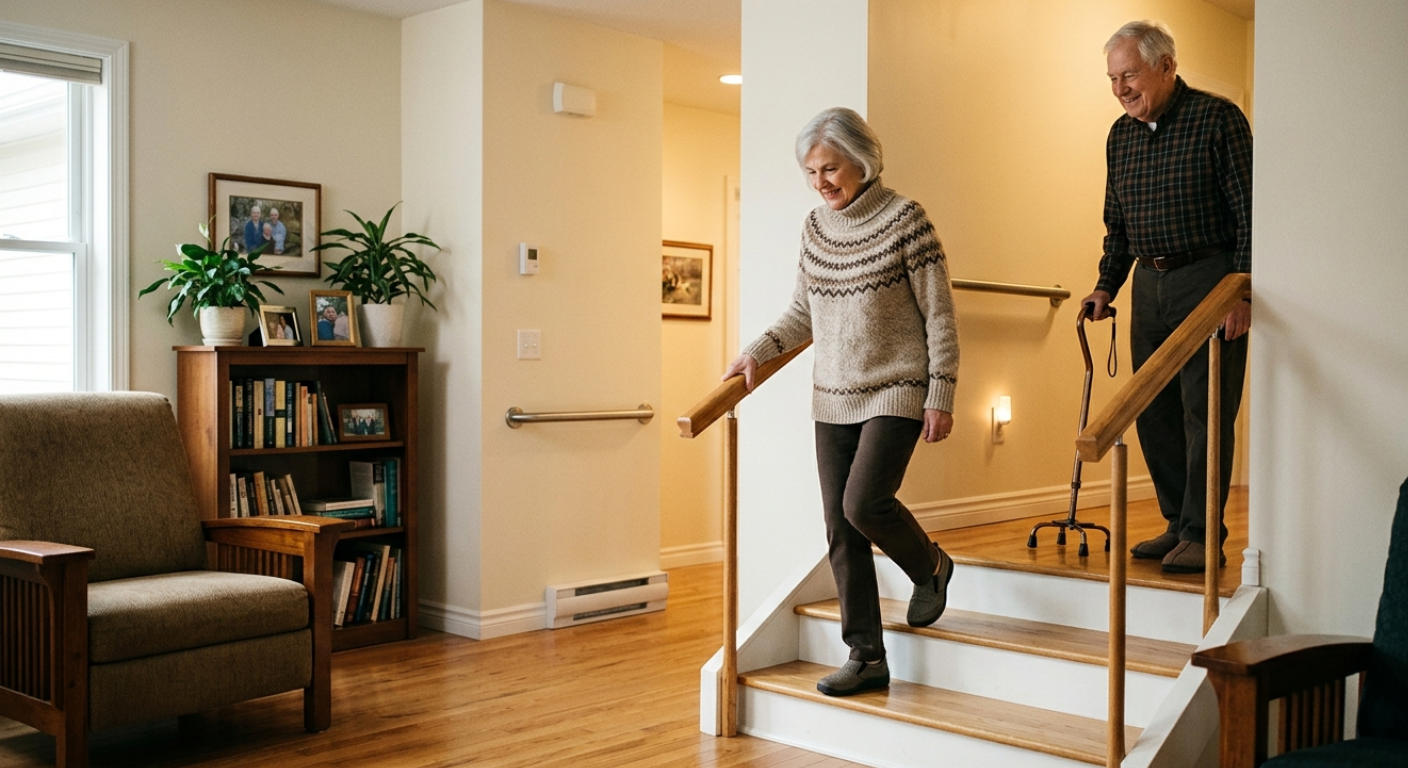
Falls in the home are one of the most preventable causes of injury, yet they remain a significant concern for households across Ireland. Whether the risk stems from slippery bathroom floors, uneven thresholds, or simply the demands of carrying items from one room to another, many everyday environments contain hazards that are straightforward to address once identified. The good news is that effective fall prevention at home does not require a full renovation — in most cases, a combination of targeted mobility aids, practical safety products, and simple habit adjustments can make a meaningful difference to the safety and confidence of those living independently.
At elderlycareproducts.ie, we work with trusted suppliers including Timago and Fleming Medical to offer a curated range of products designed to support steady, confident movement throughout the home. This guide walks through the key risk areas, the most effective solutions available, and the practical steps you can take to create a safer living environment from room to room.
From the bathroom to the bedroom, the kitchen to the hallway, fall prevention is about making the home work better for the people who live in it — supporting independence at every step, quite literally.
Understanding Fall Risks at Home: Where and Why Falls Happen
Before investing in any particular product or making changes to the home, it helps to understand where falls most commonly occur and what conditions tend to contribute to them. This room-by-room awareness allows for more focused, effective action rather than a scattergun approach.
The Bathroom: The Highest-Risk Room
The bathroom is consistently identified as the room where falls are most likely to occur. Wet, smooth surfaces combine with awkward movements — stepping over a bath edge, rising from the toilet, or turning in a confined space — to create a challenging environment. Poor lighting and the absence of support points make the situation worse.
- Wet floors around the shower or bath are a leading cause of slips
- The motion of getting up from or lowering onto the toilet places strain on balance
- Stepping in and out of the bath requires significant coordination and lower-body strength
- A lack of handles or rails means there is often nothing stable to hold onto
Hallways, Stairs, and Thresholds
Transition areas — the spaces between rooms — present their own hazards. Loose rugs, changes in floor surface, poor lighting, and steep or uneven stairs can all contribute to a loss of footing. Hallways are often narrow and cluttered, leaving little room to recover balance once it begins to shift.
The Kitchen and Living Areas
In everyday living spaces, the risks tend to be more subtle. Reaching for items on high shelves, carrying heavy or awkward loads, or navigating around furniture can all disturb balance. Kitchen floors, particularly tiled ones, become hazardous when wet.
Bathroom Safety Products: Practical Solutions That Work
Given that the bathroom presents the greatest fall risk in the home, it is often the most worthwhile place to start when assessing safety. Fortunately, a range of well-designed products can dramatically improve bathroom safety without significant structural work.
Grab Rails and Handles
Grab rails are among the most effective single interventions for improving bathroom safety. Positioned correctly beside the toilet, within the shower area, or alongside the bath, a well-anchored grab rail provides a stable support point precisely where balance is most likely to be tested. Grab rails should be fixed to wall studs or solid masonry rather than plasterboard alone — professional fitting is strongly recommended.
When choosing a grab rail, consider the grip surface, the weight capacity, and the positioning angle. Angled or articulating rails can be particularly useful where space is limited, allowing the user to push up from a seated position with controlled force distribution.
Non-Slip Bath and Shower Mats
A non-slip mat placed inside the shower tray or bath adds an important layer of friction underfoot. Look for mats with strong suction cups on the underside and a textured upper surface. A separate non-slip mat outside the bath or shower catches water on exit and prevents wet feet from slipping on a tiled floor.
Raised Toilet Seats and Toilet Frames
For those who find the motion of lowering and rising from a standard toilet height physically demanding, a raised toilet seat reduces the range of motion required. Toilet frames — freestanding structures that provide arm rests on either side of the toilet — offer additional push-up support, improving stability and confidence during one of the most routine but physically taxing daily tasks.
Explore our bathroom safety range at elderlycareproducts.ie to find grab rails, bath seats, and non-slip solutions suited to a range of home layouts.
Mobility Aids for Safer Movement Throughout the Home
Supporting steady movement beyond the bathroom is equally important when addressing fall prevention at home. Mobility aids are not just for use outdoors — many are specifically designed to provide stability and confidence across all indoor environments.
Rollators: Support With Freedom of Movement
A rollator — a wheeled walking frame with hand brakes — provides a stable, manoeuvrable support point for those who benefit from additional balance assistance when moving around the home. Unlike fixed walking frames, rollators allow a natural walking gait and many models include a built-in seat, making it easy to pause and rest when needed.
Timago rollators, available through elderlycareproducts.ie, are designed with ergonomic grips, height-adjustable handles, and responsive hand brakes. Indoor rollator models tend to have a narrower frame and smaller wheels suited to navigating hallways and doorways with ease. Delivery from our Timago range typically takes 5–7 working days.
Walking Sticks and Quad Canes
For those who require a more modest level of support, a well-fitted walking stick or quad cane can significantly reduce the risk of a trip or stumble. Adjustable-height models ensure the stick is set at the correct ergonomic position, with the handle sitting at wrist height when the arm hangs naturally. Quad canes — which feature a small four-point base rather than a single tip — offer greater stability, particularly when navigating uneven surfaces or rising from a chair.
Wheelchairs for Indoor Use
Where independent mobility is more limited, a compact indoor wheelchair allows safe, comfortable movement around the home with the assistance of a carer. Narrower-frame transit chairs are designed specifically to pass through standard household doorways and can be an important part of a broader fall prevention strategy where unassisted movement carries significant risk.
Browse our rollator range at elderlycareproducts.ie or view our wheelchair collection for indoor mobility solutions.
Home Modifications and Daily Living Aids That Reduce Fall Risk
Beyond dedicated mobility aids, a number of practical home adjustments and daily living products can meaningfully reduce fall risk across the home. Many of these require minimal effort to implement but can have a significant ongoing impact on safety.
Lighting: One of the Most Overlooked Risk Factors
Poor lighting is a significant and frequently underestimated contributor to falls in the home. Ensuring that stairways, hallways, and bathrooms are well lit — particularly during night-time hours — is a straightforward and low-cost intervention. Motion-activated night lights along the route from bedroom to bathroom are particularly useful, removing the need to locate a switch when partially awake and reducing the time spent in darkness.
- Install motion-sensor night lights in hallways and bathrooms
- Replace dim bulbs with bright LED alternatives throughout the home
- Ensure light switches are accessible from both ends of a staircase
- Consider illuminated switch plates that glow in the dark
Removing and Securing Trip Hazards
A thorough walkthrough of the home with trip hazards in mind is one of the most valuable exercises in fall prevention. Common hazards include:
- Loose or curling rugs and mats — remove them entirely or secure edges with anti-slip backing or tape
- Trailing electrical cables — route cables along walls and use cable management clips
- Clutter in hallways and on stairways — keep all walkways clear
- Raised door thresholds — address with threshold ramps where necessary
Reaching Aids and Perching Stools
Overreaching — stretching upward for items on high shelves, or bending down to low cupboards — is a common precursor to loss of balance. A long-handled reaching aid removes the need for hazardous stretching, while a perching stool in the kitchen allows tasks such as food preparation to be completed at a supported, semi-standing position rather than in tiring unsupported postures that compromise balance.
Explore our daily living aids collection at elderlycareproducts.ie for reaching tools, perching stools, and other practical home safety products.
Joint Supports and Their Role in Fall Prevention
Stability when walking and moving around the home is directly influenced by the strength and comfort of ankles, knees, and other joints. Where discomfort or instability in these joints affects gait or confidence, a suitable joint support can provide both physical reinforcement and proprioceptive feedback — the sensory awareness of where limbs are in space — that helps maintain controlled, balanced movement.
Fleming Medical joint supports, available from elderlycareproducts.ie with delivery in 3–5 working days, include ankle braces, knee supports, and wrist supports suitable for daily wear. These are functional supports designed to assist confident movement — they do not replace professional medical assessment, and anyone experiencing persistent joint pain or instability should consult a GP or physiotherapist.
View our joint supports range at elderlycareproducts.ie for supports suited to everyday independent living.
Frequently Asked Questions: Fall Prevention at Home
What is the single most effective change I can make to prevent falls at home?
There is no single universal answer, as the most effective change depends on the specific risks present in a given home. However, improving bathroom safety — through grab rails, non-slip mats, and raised toilet equipment — is consistently identified as one of the highest-impact interventions, given that the bathroom is statistically the most common location for falls in the home. A broader home hazard review covering lighting, trip hazards, and mobility support across all rooms will deliver the most comprehensive results.
Are rollators suitable for indoor use?
Yes. Many rollator models are specifically designed or well-suited to indoor use, with narrower frames, smaller wheels, and smooth-turning castors that navigate household doorways and tight hallways effectively. Height-adjustable handles and hand brakes make them practical across a range of surfaces. If the primary use will be indoors, look for a compact or narrow-frame model specifically suited to household dimensions.
How should I choose the right grab rail for my bathroom?
Consider the location — beside the toilet, within the shower, or alongside the bath — as each benefits from a different mounting position and angle. Angled or vertical rails suit different actions (pushing up versus maintaining upright balance). Always ensure the rail is rated for the appropriate weight and is fitted into a structurally sound wall surface. Professional fitting is strongly recommended to ensure the rail will hold under pressure.
Can non-slip mats alone make a bathroom safe?
Non-slip mats are an important element of bathroom safety but are best used as part of a broader approach that also includes grab rails, appropriate toilet height, and good lighting. On their own, mats address only wet-floor slip risk and do not support the movements — rising, lowering, stepping — that frequently precede bathroom falls.
Should I consult a professional before making changes to my home?
For significant modifications such as installing grab rails, stair rails, or ramps, professional assessment is advisable. An occupational therapist can carry out a home assessment and make tailored recommendations based on the specific layout of the property and the needs of the occupants. Some modifications may also be eligible for grant support through local authority schemes in Ireland — it is worth contacting your local authority to enquire about the Housing Adaptation Grant or the Mobility Aids Grant Scheme.
What flooring is safest for fall prevention at home?
Smooth, hard flooring such as polished tiles or hardwood can become slippery, especially when wet. Textured tiles, non-slip vinyl, or low-pile carpet offer better grip underfoot. Where hard flooring is already in place, non-slip rugs with secure anti-slip backing — or the removal of loose rugs altogether — and the use of non-slip footwear or slippers with grip soles are effective practical measures.
Creating a Safer Home, Step by Step
Fall prevention at home is most effective when approached systematically rather than reactively. Starting with a room-by-room review, identifying the highest-risk areas, and addressing them with a combination of practical products and sensible adjustments creates a cumulative improvement in safety that is far greater than any single product can deliver alone. The bathroom is the logical starting point for most homes, but the benefits of improved lighting, cleared walkways, and appropriate mobility support extend throughout every room.
At elderlycareproducts.ie, we are committed to providing high-quality mobility aids, bathroom safety products, joint supports, and daily living aids that support confident, independent living in the home. Whether you are assessing your own home or helping someone you care about, our range — sourced from trusted suppliers Timago and Fleming Medical — is designed to offer practical, dignified solutions for everyday life. Browse our full collection online and take the first step towards a safer home today.