
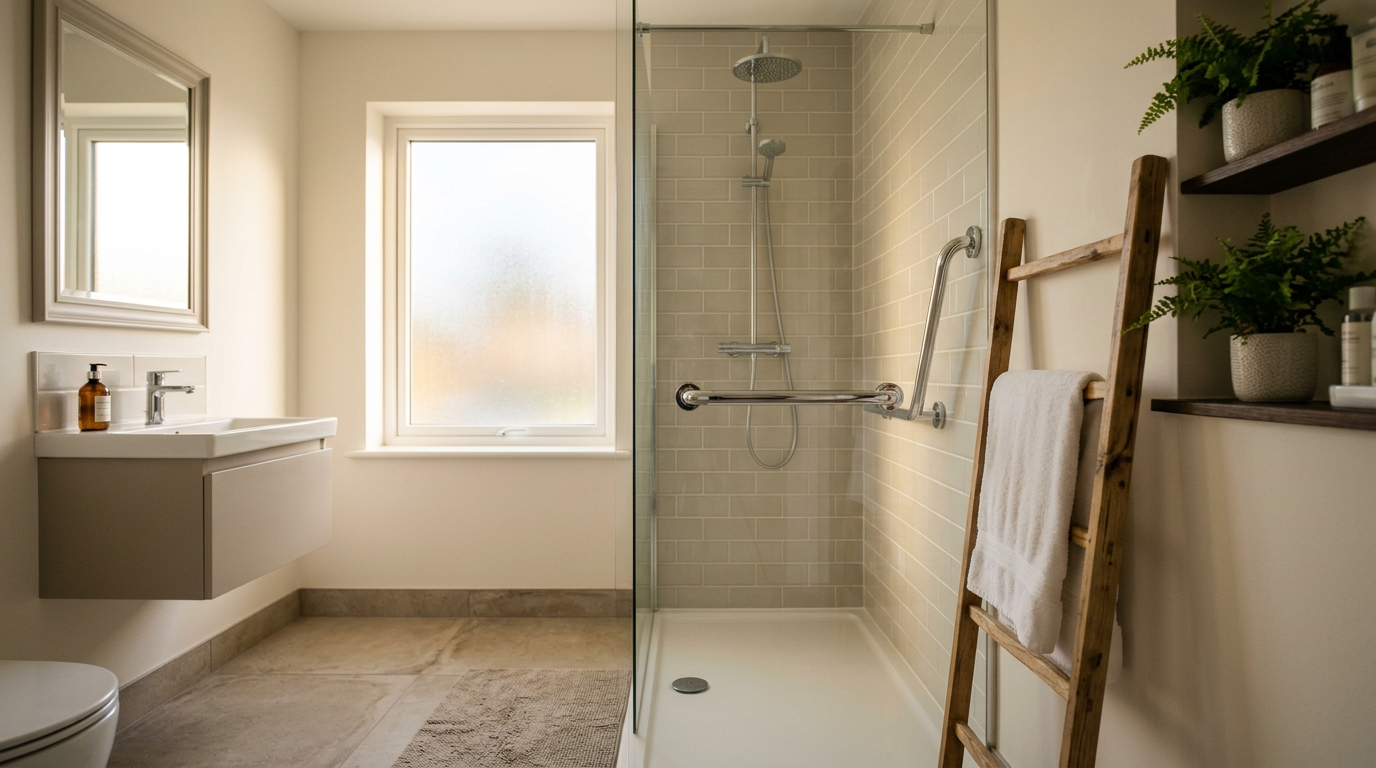
Choosing the right grab rail for your bathroom can make an enormous difference to everyday confidence and safety at home. Whether it is beside the shower, next to the toilet, or along the bath, a well-positioned grab rail provides a secure handhold that supports steady, independent movement throughout one of the most used rooms in the house. With so many options available — different lengths, finishes, fixing methods, and weight ratings — it can be difficult to know where to start.
This guide is designed to help you cut through the noise. We have outlined the key types of bathroom grab rails available in Ireland, what to look for before you buy, how they are typically installed, and how to match the right rail to the right location. Whether you are fitting out a new wet room, adapting an existing family bathroom, or simply adding extra reassurance to a well-loved home, you will find clear, practical advice here.
At elderlycareproducts.ie, we stock a carefully selected range of mobility and independent living aids suited to Irish homes. Our team understands that the best grab rails for bathrooms are those that combine solid engineering with thoughtful design — rails that look at home in a modern bathroom while delivering the grip and stability that matters most.
Types of Grab Rails for Bathrooms
Not all grab rails are created equal. Understanding the different types available will help you choose the most appropriate option for each specific location in your bathroom. The key categories are fixed wall-mounted rails, floor-to-ceiling poles, fold-down rails, and clamp-on or suction rails.
Fixed Wall-Mounted Grab Rails
Fixed grab rails are the most common and widely recommended option for bathrooms. Screwed directly into wall studs or with appropriate fixings into tiled surfaces, these rails offer a permanent, high-load-bearing solution. They come in straight and angled variants, with lengths typically ranging from 300mm to 900mm.
- Straight rails are ideal for positioning horizontally beside a toilet or along the length of a bath, offering a consistent handhold for lowering and rising.
- Angled rails (typically set at 45 degrees) are particularly useful beside showers and baths where the movement involves both a vertical and horizontal component.
- Vertical rails work well beside shower cubicle entrances, giving a secure grip when stepping over a threshold.
Most quality fixed grab rails are rated to support loads of 100–150kg or more, making them suitable for a wide range of users. Always verify the weight rating before purchasing, and ensure the wall behind the fixing point can bear the intended load.
Floor-to-Ceiling Grab Poles
Floor-to-ceiling poles are a popular choice where drilling into walls is not possible — for example, in rented properties, listed buildings, or tiled bathrooms where the homeowner prefers not to drill. These poles use tension to lock securely between floor and ceiling, and many models feature a horizontal support bar that can be positioned at any height along the pole.
While floor-to-ceiling poles do not require wall fixings, they should still be installed on a firm, level floor and a solid ceiling. They are best suited to open bathroom layouts rather than narrow spaces where the pole itself could become an obstacle.
Fold-Down Grab Rails
Fold-down rails — also called flip-up or hinged rails — are an excellent space-saving solution, particularly beside the toilet. When not in use, the rail folds flat against the wall, keeping the bathroom uncluttered. When needed, it swings down into a horizontal position, providing support on both sides.
Many fold-down models also incorporate a toilet roll holder or small shelf, making them a practical dual-purpose fitting. Look for powder-coated steel or stainless steel construction for durability in a damp environment, and check that the locking mechanism holds firmly under load.
Suction and Clamp-On Rails
Suction grab rails attach to smooth, non-porous surfaces without any drilling. They are highly portable and easy to reposition, which makes them useful as a temporary solution — when visiting a hotel or staying with family, for example. However, suction rails should never be treated as a permanent or primary safety solution. Suction strength can be reduced by moisture, soap residue, or surface imperfections, and they carry significantly lower weight ratings than fixed rails.
Clamp-on bath rails attach to the rim of a bathtub and provide a grab point for getting in and out. Again, these are best used as supplementary aids rather than a primary support, and the bath rim must be in good condition for a clamp fitting to be secure.
What to Look for When Choosing Bathroom Grab Rails in Ireland
Once you understand the types available, there are several practical considerations that will guide you towards the right product. Getting these details right at the outset saves time, money, and the frustration of a mismatched purchase.
Weight Rating and Load Capacity
This is the single most important specification. Every grab rail should carry a clearly stated maximum load rating. For a fixed wall-mounted rail, a minimum of 100kg is generally recommended, with many quality products rated to 135kg or 150kg. Always select a rail rated comfortably above the anticipated load — the higher the rating, the greater the structural margin of safety.
Material and Finish
Bathrooms are humid, wet environments, and grab rail materials must be able to withstand repeated exposure to water and cleaning products without corroding or degrading.
- Stainless steel offers excellent corrosion resistance and a clean, contemporary appearance. It is one of the most durable options available.
- Powder-coated steel is robust and available in a wide range of colours and finishes, though the coating can chip over time if knocked repeatedly.
- Nylon or reinforced plastic rails are lightweight and completely rust-proof, though they may feel less premium and some models carry lower weight ratings.
- Brushed or polished chrome finishes are popular for their aesthetic appeal in modern bathrooms, and quality chrome plating over solid brass or steel offers strong corrosion resistance.
Diameter and Grip Comfort
The diameter of the rail tube affects how comfortably it can be gripped. Most standard grab rails have a tube diameter of 32mm to 38mm — a range that suits most hand sizes and allows a firm, confident hold. Rails with a textured or ribbed surface, or those with a non-slip coating, provide extra grip when hands are wet.
Length and Positioning
Matching the rail length to its location is important. A rail that is too short may not provide the full range of support needed, while one that is too long may protrude into the space in an awkward way. As a general guide:
- Beside a toilet: a horizontal rail of 400–600mm is typically effective
- Along a bath: a 600–900mm horizontal rail positioned at the waterline height allows a consistent grip along the length
- Beside a shower entry: a vertical rail of 300–450mm gives a firm handhold when stepping in and out
- Inside a shower: an angled or horizontal rail at mid-chest height supports balance during washing
Compliance and Standards
Look for grab rails that meet relevant European or British Standards for load-bearing bathroom aids. Products designed and tested to recognised standards — such as BS 8300 or equivalent — give far greater assurance of structural performance than unverified alternatives. In Ireland, any works carried out as part of the Housing Adaptation Grant scheme will typically require fittings that meet specified standards, so checking compliance before purchase is worthwhile if you intend to apply for grant assistance.
Where to Position Grab Rails in the Bathroom
Getting the type of rail right is only part of the equation. The position of each rail is equally important. A well-placed grab rail provides support at exactly the right point in a movement sequence, whereas a poorly positioned one can actually make movement more awkward.
Beside the Toilet
The toilet is statistically the location where many bathroom falls occur, and it is typically the first place to consider fitting a grab rail. The key movement here is the sit-to-stand transition — lowering down onto the seat and pushing up to standing again. A horizontal rail positioned at approximately seat height on the dominant side, or fold-down rails on both sides, supports this movement most effectively. The rail should extend far enough forward to allow the user to push through the full range of the standing motion.
Beside and Inside the Bath
Getting into and out of a bath involves a stepping-over movement combined with a controlled descent — one of the more demanding transitions in the bathroom. A vertical rail positioned on the wall beside the tap end of the bath provides a grip for the initial step in. A horizontal rail along the wall above the bath, at approximately elbow height when seated, supports washing and rising from a reclined position. Some households also fit a clamp-on bath rail as a supplementary aid, though this should complement rather than replace a fixed solution.
In and Around the Shower
For walk-in showers or wet rooms, a vertical rail beside the entry point helps with stepping in and out. Inside the shower enclosure, an angled or horizontal rail at mid-chest height provides balance support during washing. In larger walk-in showers with a built-in seat or shower stool, additional rails may be appropriate at seat height on either side.
Along Corridors or Steps Leading to the Bathroom
It is worth considering the approach to the bathroom as well as the bathroom itself. A grab rail or short handrail in a narrow hallway, beside a step up to the bathroom door, or at the entrance to a wet room can complete a continuous line of support from one room to another — making the journey to and from the bathroom feel safer and more secure at every stage.
If you are also considering wider mobility support around the home, our range of rollators and walking frames can complement fixed bathroom fittings and help maintain confident, steady movement throughout the house.
Installation Guidance for Bathroom Grab Rails
Even the best grab rail is only as good as its installation. Incorrect fixing is the primary cause of grab rail failure, and a poorly fixed rail that pulls away from the wall under load is potentially more hazardous than no rail at all.
Locating the Right Wall Fixings
In a tiled bathroom, the wall behind the tiles may be plasterboard, timber studwork, blockwork, or solid masonry. The fixing method must be appropriate to the substrate:
- Solid masonry or blockwork: use a hammer drill with masonry bit and appropriate masonry anchors. This is the most straightforward and reliable fixing type.
- Timber studs behind plasterboard: fix directly into the stud with screws of adequate length and gauge. Stud finders can help locate studs behind tiles, but a professional assessment is advisable.
- Hollow plasterboard with no stud: use specialist cavity wall anchors rated for the anticipated load. This is the most challenging scenario, and professional installation is strongly recommended.
Tiling Considerations
Drilling through ceramic or porcelain tiles requires a diamond-tipped tile drill bit used at low speed without hammer action until through the tile, then switching to hammer action for the wall behind. Rushing this step risks cracking expensive tiles. Apply masking tape over the drill point to prevent the bit from wandering, and use a water spray or damp sponge to keep the bit cool.
Professional Installation
For peace of mind — particularly where the rail will see regular use or where the wall structure is uncertain — professional installation by a qualified tradesperson is the recommended approach. Many local handyman services and specialist bathroom fitters in Ireland are experienced in grab rail installation. The cost is typically modest relative to the assurance it provides.
Frequently Asked Questions About Grab Rails for Bathrooms
What is the best position for a grab rail beside a toilet in Ireland?
The most effective position is a horizontal rail on the dominant side of the toilet, mounted at approximately seat height and extending far enough forward to support the full sit-to-stand movement. Fold-down rails on both sides offer the most complete support and are a popular choice in Irish homes. If in doubt, a professional occupational therapist assessment can provide a personalised recommendation.
Can grab rails be fitted to tiled bathroom walls?
Yes, grab rails can be successfully fitted to tiled walls, but it requires the correct drill bit and technique to avoid cracking tiles. A diamond-tipped tile bit used at low speed is essential for ceramic and porcelain tiles. The strength of the fixing ultimately depends on what lies behind the tiles — solid masonry offers the most secure base, while hollow plasterboard requires specialist cavity anchors and ideally professional installation.
Are suction grab rails safe to use in the bath or shower?
Suction grab rails are suitable only as a temporary or supplementary aid on smooth, non-porous surfaces. They should not be relied upon as a primary support, as moisture, soap residue, and surface imperfections can all reduce suction strength without warning. For consistent, day-to-day support, a permanently fixed wall-mounted rail is the recommended choice.
What weight capacity should a bathroom grab rail have?
As a general guideline, look for a grab rail rated to a minimum of 100kg, and ideally 135kg or above for a fixed wall-mounted rail. The weight rating should be clearly stated by the manufacturer and tested to a recognised standard. Always choose a rating comfortably above the anticipated load to ensure an adequate safety margin.
Is there financial assistance available in Ireland for fitting grab rails?
Yes. The Housing Adaptation Grant for People with a Disability and the Housing Aid for Older People scheme, administered by local authorities across Ireland, can provide financial assistance towards the cost of bathroom adaptations including grab rails. Eligibility criteria and grant levels vary by local authority. It is advisable to contact your local county council or city council directly to find out what is available in your area before commencing any works.
How long does a good quality grab rail last?
A correctly installed stainless steel or powder-coated steel grab rail in a domestic bathroom should last many years with minimal maintenance. Occasional cleaning with a mild, non-abrasive bathroom cleaner is usually all that is required. It is good practice to check the fixings periodically — particularly after the first few months of use — to confirm that no movement has developed in the wall anchors.
Conclusion
The best grab rails for bathrooms are those that match the specific location, the wall structure, and the movement being supported — and that are installed securely enough to be trusted every single day. Whether you are fitting a single rail beside the toilet or planning a comprehensive set of supports throughout a fully adapted bathroom, taking time to choose the right product and fix it correctly will pay dividends in confidence and peace of mind for years to come.
At elderlycareproducts.ie, we are committed to helping Irish households find practical, well-made mobility and independent living solutions. Explore our full range of products designed to support steady, confident movement at home — and if you have questions about any of our products, our team is always happy to help.